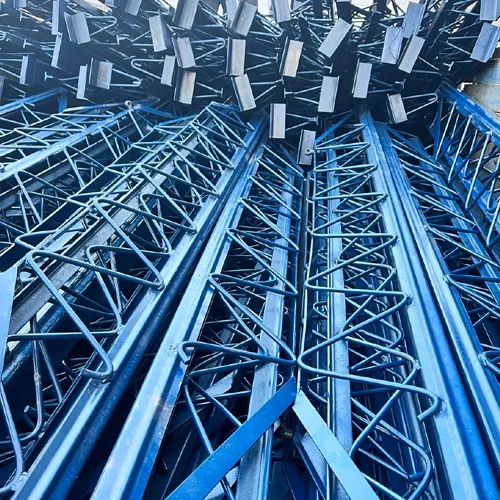
An adjustable scaffolding span (also known as an acrow span or telescopic span) is a key component in construction formwork, used to provide adjustable horizontal support for bearing loads, especially during the casting of reinforced concrete (RCC) slabs. Its primary benefit is eliminating the need for time-consuming and costly cutting of timber to specific lengths for each job. Key Details and Features Function: The main purpose is to support formwork (the temporary molds into which concrete is poured) across varying distances between vertical supports (like props or standards). Adjustability: The span is telescopic, featuring inner and outer members (usually made of mild steel) that slide within each other to achieve the required length for a specific application. A simple yet robust locking mechanism is used to secure the desired length. Material: They are typically made from high-quality mild steel (MS), often with a painted or galvanized finish for corrosion resistance and durability. Design & Components: Main Members: Consist of inner and outer sections of specific dimensions (e.g., a 40 Nb inner and 50 Nb outer tube). Bearing Angles: Angles at the ends (e.g., 75 x 75 x 8 mm) rest on the vertical supports. Lattice: Diagonal bracing (often 10 mm diameter MS round bar) connects the top and bottom plates of the span, providing strength and load-bearing capacity. Welding: Components are usually joined using CO₂ MIG welding to ensure structural integrity. Load Bearing Capacity: The load capacity of an adjustable span is a critical engineering specification and depends heavily on its extended length, material specifications, and design. Scaffolding components are generally required by safety regulations (such as OSHA) to be capable of supporting at least four times their maximum intended load. Manufacturers provide load charts detailing maximum safe loads for different span extensions. For example, specific acrow spans may have a maximum permissible centerline spacing of 3.38 m for certain slab thicknesses. Safety: The platform or span must not deflect more than 1/60 of the span when under the intended load, and a competent person must supervise their erection and use to ensure all safety standards are met. In essence, adjustable spans provide a flexible, strong, and reusable alternative to traditional timber components in formwork systems, boosting efficiency and safety on construction sites.

Coimbatore
08043692962
+919994767762
 Chat with us
 Chat with us